Latest Post
Progress Report
Two years down, I’m still going. The next two years are my clinical rotations, the actual hands-on training. It’s a scary prospect, responsibilities and such; but it’s equally exciting, after all, this is what I came here for. I’ll let you know how it goes since I actually have no idea what it’ll be like.
I want to share something that one of my tutors described, the big picture. The timeline below depicts the course of an individual presenting with a typical complaint (ex. cold, shortness of breath, etc). Treating a person is an investigation centered around understanding their health timeline. I’ll describe the points in the timeline in detail below, each point also corresponds to a part of the note that your doctor creates for each encounter.
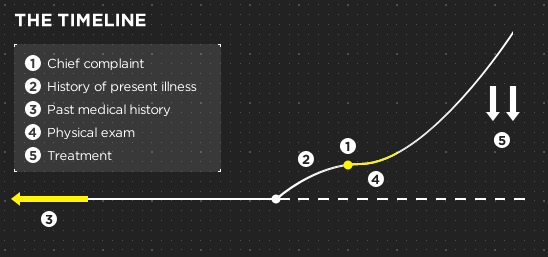
- The person comes in with a problem, a “chief complaint”. This is already a serious problem for the patient, having become significant enough to outweigh all their other obligations.
- Prior to their presentation today, the patient had a progressive worsening of symptoms. This could have been a fairly rapid progression (ex. the minutes after a car accident), or their condition could have taken a more insidious course (ex. progressively worsening shortness of breath). A critical part of the investigation is understanding what happened in this intervening time, the “history of present illness”. How long has this problem been happening, what can the person tell me about the quality, severity and duration of the problem?
- Of course, there’s a lot more to the story than the time during which symptoms became evident. This part corresponds to several important aspects of the patient’s history that can contribute to a better understanding of the current problem: “past medical history”, “past surgical history”, family history, “social history” (this includes things like work/school history, safety, alcohol and substance use, sexual history), medications, etc.
- The final portion of the information-gathering phase is the physical exam. These are the diagnostic tests and maneuvers that add some objective facts (signs) to the subjective descriptions (symptoms) provided by the patient.
- The final part of the timeline is where we use all the information we’ve gathered to create an “assessment and plan” and hopefully alter the course of the patient’s current diversion.
That’s a pretty basic summary of what’s going on in every visit. Hopefully it’ll help you understand a bit more about the process the next time you see your doctor.

Archive
-
260.
The Ethics of Practicing Procedures on the Nearly Dead
The report from the field was not promising by any stretch, extensive trauma, and perhaps most importantly unknown “downtime” (referencing the period where the patient received no basic care like...
-
260.
The Ethics of Teaching Hospitals
I can’t imagine what the patient was thinking. Seeing my trembling hands approaching the lacerations on his face with a sharp needle. I tried to reassure him that I knew what I was doing, but the...
-
260.
Conscious Conversation: Behavioral Science
Dr. Eran Zaidel is a professor of Behavioral Neuroscience and faculty member at the Brain Research Institute at UCLA. His work focuses on hemispheric specialization and interhemispheric interaction...
-
260.
Progress Report
Two years down, I’m still going. The next two years are my clinical rotations, the actual hands-on training. It’s a scary prospect, responsibilities and such; but it’s equally exciting, after...
-
260.
Why Medical School Should Be Free
There’s a lot of really great doctors out there, but unfortunately, there’s also some bad ones. That’s a problem we don’t need to have, and I think it’s caused by some problems with the...
-
260.
The Cerebellum: a model for learning in the brain
I know, it’s been a while. Busy is no excuse though, as it is becoming clear that writing for erraticwisdom was an important part of exercising certain parts of my brain that I have neglected...
-
260.
Conscious Conversation: Philosophy
Daniel Black, author of Erectlocution, was kind enough to chat with me one day and we had a great discussion – have a listen.
-
260.
The Stuff in Between
I’m actually almost normal when not agonizing over robot production details, and quite a bit has happened since I last wrote an update. First, I’ve finally graduated. I had a bit of a...