Latest Post
Frozen Worlds: a Time Puzzle
I got a bit giddy when we got to the “Space and Time” portion of my Metaphysics class. Most of my semester was spent deciphering bizarre accounts of matter (where two theories’ definitions could differ by just a single word), and I was more than ready for a change. I like the topic of Time in particular because I really have no idea what it is, and metaphysical analysis seems a bit more accessible than a purely physical approach.
Time is typically associated with change, and a famous puzzle related to this concept is Shoemaker’s “freeze world” scenario. Shoemaker’s scenario, first proposed in “Time Without Change”, describes a discrete possible world consisting of three zones: A, B and C. Under normal conditions, the inhabitants of each zone are able to observe and communicate with each other. However, a mysterious phenomenon occurs occasionally whereby all change in a zone ceases, meaning no motion, growth or decay occurs. During these “local freezes”, inhabitants of the other unfrozen zones can observe that all activity has, indeed, stopped (while their zones remain active). Individuals in the frozen zone do not immediately detect the freeze, as their activities will simply resume as if no freeze had occurred. Frozen observers focused on one of the other zones would notice large, instantaneous changes as they become acquainted with the post-freeze world. In Shoemaker’s example, these local freezes are found to occur cyclically (every three years in Zone A, every four in Zone B, and every five in Zone C) and last for one year each time. The cycles are in phase, so every sixty years, the frozen periods of each zone align to create a “total freeze” where absolutely no change occurs in the entire world. The term of this total freeze would be undetectable to the world’s inhabitants who had previously referenced other zones’ clocks or their own perception of other zones’ change to recognize the freeze. This scenario establishes the idea that one in sixty years will be what Shoemaker calls a “changeless interval”.
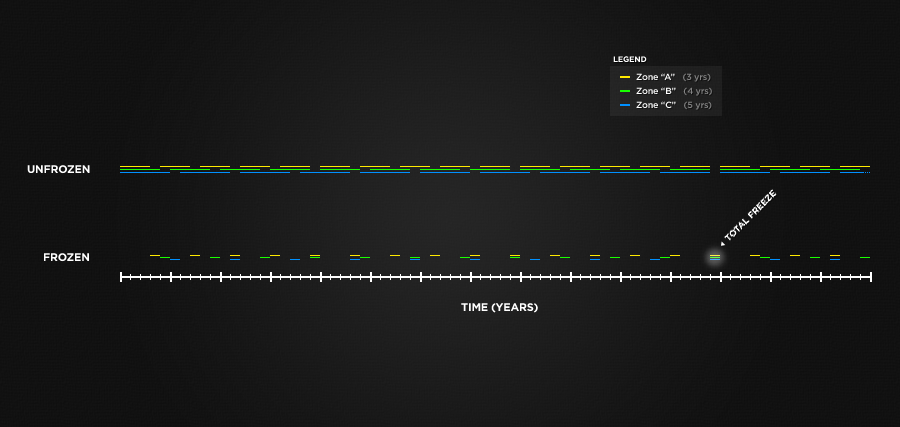
The importance of these total freezes is that they dissociate the passage of time from the occurrence of events in the world (that our normal conception of time requires). However, there are a few inconsistencies in Shoemaker’s scenario that prevent it from convincingly proving its conclusion. For anyone interested, I discuss some of the more theoretical problems in this paper I submitted in the course. I’ll explain some quick ones here.
The first is a physical problem with the scenario. As far as we can understand, motion and change are critical to the very persistence of matter. The constant movement and vibration of atoms and subatomic particles are required to maintain the tenuous structural and electrical integrity of these entities. Take the phenomenon of absolute zero, for example, the temperature (0K, -273°C) at which molecular motion mostly ceases. Reaching absolute zero is theoretically impossible, an asymptotic limit not unlike the speed of light. Even approaching absolute zero causes wild variations in a substance’s properties including quantum effects like superconductivity. The impossibility of reaching absolute zero therefore raises serious doubts on the feasibility of Shoemaker’s scenario.
Another critique of Shoemaker is theoretical in nature and involves the ideas of time and change in the “freeze world” scenario. The terms are not well defined, and the lack of clarity ultimately leaves Shoemaker begging the question. What exactly does it mean for time to pass in frozen zones, what do these “changeless intervals” refer to? In the scenario, time can be observed to pass when one or two zones are frozen because of the remaining reference zone(s). When the frozen zones thaw, they can consult clocks or observers in the unfrozen zone to learn that their zone had indeed been in a freeze. However, in a total freeze, no such reference exists, and to say that the zones continue frozen for one year is to gratuitously assume the conclusion that changeless time is possible. During the single local freezes, the passage of time is still relative to changes occurring in the unfrozen zone(s). To inhabitants of the frozen zone, the one year freeze passes instantaneously and would have gone unnoticed were it not for observers in the unfrozen zones. However, during the total freeze, all changes in the world cease, and without the reference of changes in unfrozen zones, the intervening period does pass instantaneously and inhabitants of the world would never know. Shoemaker’s scenario is therefore reducible to the total freeze (there is still time and change during single local freezes), and the conclusion that there is a one-year changeless interval is not adequately supported.
These problems mostly disprove the scenario for me. What do you think, is changeless time possible?
Post Meta
- At
- 10:34:28 AM
- On
- December 23
- In
- Time Metaphysics
- By
- Tom Fadial
- Comment
- Play Related Track
Archive
-
260.
The Ethics of Practicing Procedures on the Nearly Dead
The report from the field was not promising by any stretch, extensive trauma, and perhaps most importantly unknown “downtime” (referencing the period where the patient received no basic care like...
-
260.
The Ethics of Teaching Hospitals
I can’t imagine what the patient was thinking. Seeing my trembling hands approaching the lacerations on his face with a sharp needle. I tried to reassure him that I knew what I was doing, but the...
-
260.
Conscious Conversation: Behavioral Science
Dr. Eran Zaidel is a professor of Behavioral Neuroscience and faculty member at the Brain Research Institute at UCLA. His work focuses on hemispheric specialization and interhemispheric interaction...
-
260.
Progress Report
Two years down, I’m still going. The next two years are my clinical rotations, the actual hands-on training. It’s a scary prospect, responsibilities and such; but it’s equally exciting, after...
-
260.
Why Medical School Should Be Free
There’s a lot of really great doctors out there, but unfortunately, there’s also some bad ones. That’s a problem we don’t need to have, and I think it’s caused by some problems with the...
-
260.
The Cerebellum: a model for learning in the brain
I know, it’s been a while. Busy is no excuse though, as it is becoming clear that writing for erraticwisdom was an important part of exercising certain parts of my brain that I have neglected...
-
260.
Conscious Conversation: Philosophy
Daniel Black, author of Erectlocution, was kind enough to chat with me one day and we had a great discussion – have a listen.
-
260.
The Stuff in Between
I’m actually almost normal when not agonizing over robot production details, and quite a bit has happened since I last wrote an update. First, I’ve finally graduated. I had a bit of a...